Selecting the wrong packaging machinery is more than just a procurement error; it creates a permanent bottleneck in your production line. Whether it's fine powder dust causing cross-contamination or delicate granules being crushed during sealing, equipment mismatch leads to significant product waste, inconsistent quality, and regulatory risks.
In an era where sustainability regulations (such as the EU's clampdown on single-use plastics) and labor shortages are reshaping the industry, making an informed decision is critical. This guide provides a structured approach to selection—moving from product physical analysis (powder, granule, liquid) to defining throughput targets, accuracy requirements, and calculating ROI. Whether you're upgrading a single station or deploying a turnkey line, this framework will help you choose the right automatic packaging solution.
This guide is written for plant managers, engineering managers, and purchasing officers tasked with optimizing production lines. It's structured to serve both large-scale facilities looking for high-speed automation and smaller manufacturers seeking cost-effective entry points.
Navigation Tips:
Small Manufacturers: Focus on "Step 1" and "Step 5" to balance budget with versatility
High-Speed Lines: Jump to "Step 4" for integration and OEE strategies
First-Time Buyers: Read through all steps sequentially
Before looking at machine specs, you must map the physical characteristics of your product. The machine must adapt to the food, not the other way around.
You need to define three critical parameters:
1. Flow CharacteristicsIs your product free-flowing (like rice) or non-free-flowing (like sticky powders)?
2. Particle SensitivityIs it fragile (chips), dust-prone (flour), or temperature-sensitive (chocolate)?
3. Environmental RequirementsDoes it require moisture control, oxygen barriers, or modified atmosphere packaging?
Example: Packaging protein powder requires strict dust control and airtight sealing, whereas packaging potato chips prioritizes gentle handling to prevent breakage.
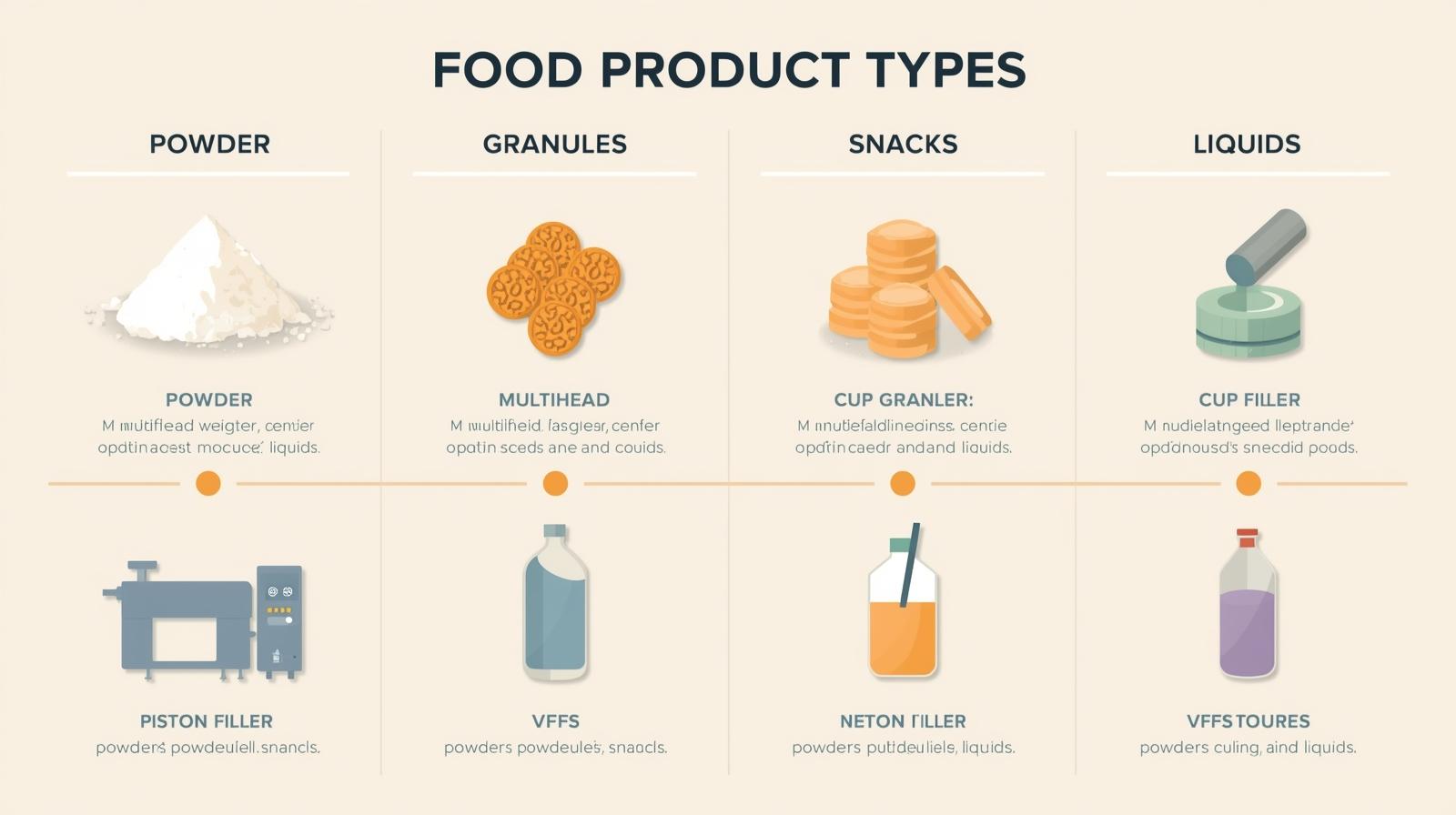
| Product Type | Examples | Recommended Equipment | Key Reason |
|---|---|---|---|
| Fine Powders | Flour, Protein, Spices | Auger Filler + VFFS | Precise dosing for non-free-flowing materials; enclosed systems prevent dust issues |
| Free-Flowing Granules | Rice, Beans, Sugar | Multihead Weigher + VFFS | Gravity-fed systems work best; high speed with weight consistency |
| Fragile Snacks | Chips, Popcorn | Low-Drop Multihead Weigher | Minimizes drop distance to keep products intact |
| Liquids & Pastes | Sauces, Juices | Piston/Pump Fillers + Flow-Wrap | Positive displacement ensures accurate volume for viscous products |
Explore Solutions:
For fine powders: Powder Pouch Packing Machine
For complete automation: Case Studies on Bagging Solutions
Your required output determines the machine class:
Short Runs (Small Batches)
Target: 10-30 bags/minute
Priority: Quick changeover capabilities over raw speed
Best for: Multi-SKU operations with frequent product changes
Medium Volume
Target: 30-60 bags/minute
Balance: Speed and flexibility
Best for: Standard food manufacturing operations
High Volume (Continuous Production)
Target: 100+ bags/minute
Equipment: Rotary systems or high-speed VFFS
Best for: Large-scale production with limited SKU variety
"Product Giveaway" refers to the amount of product you overfill to ensure legal compliance. Over the course of a year, a 2% overfill on expensive ingredients (like coffee or spices) can cost more than the machine itself.
Calculation Example:
Product: Premium Coffee @ $20/kg
Target weight: 250g per bag
Giveaway: 2% (5g extra per bag)
Annual production: 1 million bags

Annual waste cost = (5g × 1,000,000 bags) ÷ 1000 × $20 = $100,000
Solution: Advanced weighing systems, such as Auger Fillers with feedback loops, check the weight in real-time and adjust the dosage to minimize giveaway (typically reducing waste to <0.5%).
Food packaging machinery must meet strict hygiene standards. When evaluating suppliers, verify:
Sanitary Design
IP-rated enclosures (IP65/IP69K minimum)
Capable of withstanding washdowns (CIP - Clean In Place)
No crevices where bacteria can accumulate
Material Compliance
All contact parts: Food-grade stainless steel (304 or 316)
Seals and gaskets: FDA-approved materials
Tool-less disassembly for cleaning
Regulatory ComplianceEnsure the machine supports compliance with:
Local food safety laws (FDA, EFSA)
GMP (Good Manufacturing Practice)
Retail requirements (GFSI standards)
For a broader understanding of packaging functions and safety, refer to industry resources like Wikipedia: Food Packaging.
| Level | Description | Labor Requirements | Best For |
|---|---|---|---|
| Semi-Automatic | Operator loads bag; machine weighs and seals | High (2-3 operators) | Low-budget startups |
| Fully Automatic | Machine forms, fills, and seals | Medium (1 operator) | Standard production |
| Turnkey Line | Integrated: Feeding → Weighing → Packaging → Inspection → Case Packing | Low (0.5 operators) | High-volume operations |
When building a line, the biggest risk is communication failure between equipment. Ensure that your VFFS, weigher, and printer (coding machine) speak the same protocol. Poor integration kills OEE (Overall Equipment Effectiveness).
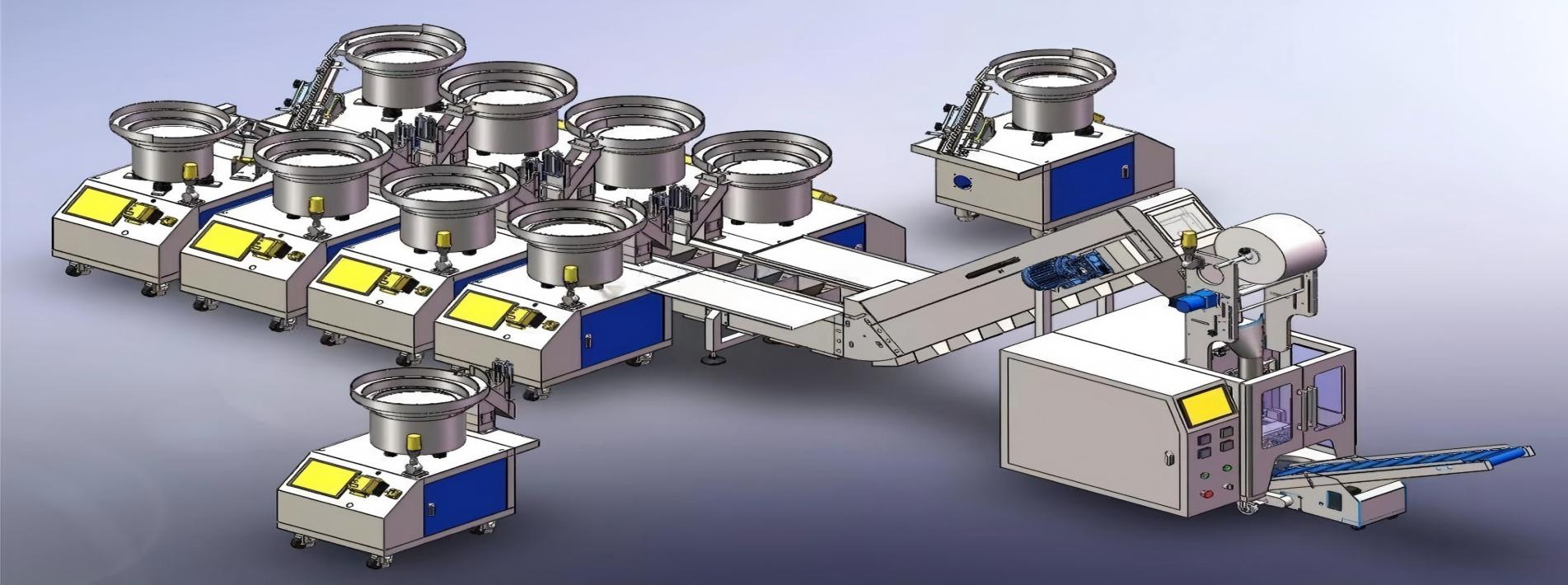
Integration Checklist:
Protocol compatibility (Ethernet/IP, Profinet, Modbus)
Synchronized timing between weighing and bagging
Unified HMI (Human Machine Interface) for monitoring
Traceability system compatibility
Tip: Check compatibility for traceability systems. Read more on Smart Packaging: Enhancing Food Safety and Traceability.
Don't just look at the sticker price (CAPEX). A true ROI calculation includes OPEX over the machine's lifespan (typically 10-15 years).
Initial Investment (CAPEX)
Equipment purchase price
Installation and commissioning
Training costs
Facility upgrades (power, compressed air)
Operating Expenses (OPEX)
Material costs (film, consumables)
Labor savings
Maintenance and spare parts
Energy consumption
Waste disposal
Annual Savings = Labor Savings + Giveaway Reduction + Material Savings + Waste Reduction

Payback Period = Total Initial Investment ÷ Annual Savings

ROI (%) = (Annual Savings - Annual OPEX) ÷ Initial Investment × 100
Typical Benchmarks:
Semi-automatic: 18-36 months payback
Fully automatic: 12-24 months payback
Turnkey lines: 24-36 months payback (but highest long-term ROI)
Include these questions in your Request for Proposal (RFP):
"Do you offer trial runs with my specific product and film?"
"What is the machine's actual uptime rate in similar installations?"
"Can you provide references from customers in my industry?"
"What is the SLA (Service Level Agreement) for spare parts delivery?"
"Do you offer local installation and training?"
"Is remote diagnostics available for troubleshooting?"
"Have you validated recyclable films on this model?"
"Does the PLC support MES/ERP integration for Industry 4.0 data collection?"
"Can the machine be upgraded for higher speeds later?"
"What warranty coverage is included?"
"Are spare parts packages or service contracts available?"
"What are the typical maintenance costs per year?"
Challenge: Manual scooping caused 5% product giveaway and persistent dust contamination issues.
Solution: Replaced with an Auger Filler VFFS system.
Results:
Product giveaway reduced from 5% to 0.5%
Eliminated dust-related contamination
ROI achieved in 14 months
See how similar solutions work on our Powder Packing Product Page.
Challenge: Manual bagging limited throughput to 20 bags per minute.
Solution: High-speed Multihead Weigher integration.
Results:
Throughput increased to 60 bags per minute (3x improvement)
Labor reduced from 4 to 1 operator
Payback period: 18 months
Challenge: Short shelf life causing high retail waste.
Solution: MAP (Modified Atmosphere Packaging) technology with nitrogen flushing.
Results:
Shelf life extended by 40%
Retail waste reduced by 25%
Premium pricing justified by longer freshness
At LTC PACK, we specialize in engineering-focused automated packaging solutions, from standalone units to complete turnkey lines.
For Fine PowdersOur Powder Pouch Packing Machines feature:
Advanced dust extraction systems
Servo-driven augers for maximum precision (±0.5% accuracy)
Tool-less changeover design
FDA-compliant stainless steel construction
For Complex LinesWe integrate multihead weighers, checkweighers, metal detectors, and case packers. View our Case Studies to see these lines in action.
For Future-ProofingWe integrate Smart Packaging technologies for traceability and compliance with evolving regulations.
Consultation: Free initial assessment of your requirements
Material Testing: Trial runs with your actual product and film
Custom Design: Tailored solution for your space and throughput
Installation: On-site commissioning and training
Support: Ongoing technical support and spare parts
Download our White Paper for detailed technical specs and ROI models.
Successful automation requires a structured plan. Use this checklist:
Conduct baseline audit (current waste, labor costs, throughput)
Define clear KPIs and success metrics
Send product samples to vendor for trial run
Verify film compatibility with machine specifications
Calculate detailed TCO and ROI
Upgrade facility power supply if needed
Install compressed air system (if required)
Prepare floor space and utilities
Plan material flow and ergonomics
Schedule operator training before machine arrival
Conduct Factory Acceptance Test (FAT)
Supervise installation and commissioning
Perform Site Acceptance Test (SAT)
Document baseline performance metrics
Monitor OEE (Overall Equipment Effectiveness) weekly
Track waste reduction and giveaway percentages
Schedule preventive maintenance
Collect operator feedback for optimization
Review ROI progress monthly
Download the Full Checklist & White Paper Here
Problem: Cheap machines often have hidden costs (downtime, spare parts, poor efficiency).
Fix: Consider Total Cost of Ownership (TCO). A machine that costs 20% more but saves 15% on materials annually pays for itself quickly.
Problem: Your preferred film supplier's material doesn't seal properly on the machine.
Fix: Always verify your specific film supplier works with the machine sealing jaws. Request sample runs before purchase.
Problem: High-mix production lines lose hours daily to changeovers.
Fix: Choose tool-less changeover designs. Modern machines can switch between products in 5-10 minutes vs. 30-60 minutes for legacy systems.
Problem: Machine arrives at your facility but doesn't perform to spec.
Fix: Never ship a machine without verifying it runs your product to specification at the factory. Document all test results.
Problem: Operators don't understand machine capabilities, leading to suboptimal performance.
Fix: Invest in comprehensive training. Well-trained operators can improve OEE by 10-20%.
A: Generally, no. Powders need augers for controlled feeding; granules need weighers for speed. However, some modular lines allow swapping the "head" (filler unit), though it increases changeover time significantly (30-60 minutes). For high-mix operations, consider two dedicated machines.
A: Timeline varies by complexity:
Standalone machine: 4-8 weeks (order to production)
Semi-automated line: 8-12 weeks
Turnkey line: 3-6 months depending on customization
Factor in additional time for facility preparation and training.
A: Yes, absolutely. A FAT allows you to:
Verify the machine runs your specific product to specification
Test different film types
Train your team before installation
Identify issues before shipping
Never skip this step, especially for custom or high-value equipment.
A: Most reputable suppliers offer 12 months from commissioning. However, look for:
Comprehensive coverage (not just mechanical failures)
Spare parts packages
Extended warranty options
Service level agreements (SLA) for response time
A: Use this formula:
Required Capacity = (Annual Production Volume ÷ Operating Days) ÷ (Hours per Day × 60) × 1.3

The 1.3 factor accounts for:
- Downtime (maintenance, changeovers)
- Future growth (30% buffer)
A: Possibly, if your current equipment:
Has a solid mechanical foundation
Uses standard components
Is less than 10 years old
However, retrofitting often costs 60-80% of new equipment while delivering only 70-80% of the performance. Evaluate carefully.
Choosing the right food packaging machine is a logic-driven process: match the machine mechanics to your product's physics, align the capacity with your business goals, and ensure hygienic compliance.Let us know this first:
Product comes first: Your product's physical characteristics dictate the machine type
Look beyond price: Total Cost of Ownership (TCO) is what matters
Test before buying: Always run trials with your actual product
Plan for integration: Ensure equipment communicates properly
Invest in training: Well-trained operators maximize ROI
Don't leave your production efficiency to chance. The right packaging machine can:
Reduce product giveaway by 80-90%
Cut labor costs by 50-70%
Improve quality consistency
Enable future growth
Ready to optimize your production line?
Download our Comprehensive White Paper for detailed machine comparisons, or Contact Us to book a sample trial run today.
Contact: LTC Bagging System
Phone: +8613337332946
E-mail: [email protected]
Add: Wenzhou, Zhejiang Province, China