In 2025, sustainable packaging procurement is no longer a competitive advantage—it's a license to operate. The global sustainable food packaging market is expanding from $301.8 billion in 2024 to a projected $406.7 billion by 2030, driven by cascading regulations (EU 2030 recyclability mandates, Extended Producer Responsibility laws), retailer purchasing scorecards, and consumer brand loyalty shifts. For procurement teams and brand managers, the critical challenge isn't whether to transition to eco-friendly materials, but how to manage the cost-supply-compliance triangle while maintaining product integrity and market responsiveness. This guide decodes material options, reveals hidden costs beyond unit price, provides a procurement decision framework, and showcases real-world adoption patterns to help you navigate the transition with minimal risk and maximum competitive advantage
Starting February 2025, the EU's Packaging and Packaging Waste Regulation (PPWR) entered force with non-negotiable milestones: by 2030, packaging must achieve at least Grade C recyclability (70% of material recoverable), escalating to Grade B (80%) by 2038, and Grade A (95%+) by 2040. This isn't a guideline—it's a market access requirement. If your packaging doesn't meet the grade, it cannot be placed on EU shelves. For brands with European distribution, this single regulation cascades backward through your supply chain immediately.
Canada, following suit with SOR/2022-138, bans most single-use plastics and mandates third-party compostable certification for alternatives. The UK, Australia, and ASEAN nations are harmonizing similar frameworks. For multinational procurement teams, the cost of maintaining multiple material libraries across regions is becoming unsustainable—the pressure is mounting toward globally acceptable materials that meet the strictest regional standard.
Major retailers—Tesco, Carrefour, Whole Foods—now use supplier sustainability scorecards that factor directly into shelf space allocation and margin negotiations. Non-compliance isn't just a regulatory risk; it's a commercial exclusion risk. A brand that can't demonstrate 90%+ recyclable packaging or verified carbon reduction is losing preferred placement and promotional support.
Here's where most procurement teams get blindsided: the upfront material cost premium for sustainable options (typically 10–30% higher per unit) is not the true total cost of ownership (TCO). The real financial picture emerges when you factor in:
Waste management fees: Eco-compliant materials often qualify for subsidies or reduced disposal costs; single-use plastics face rising landfill taxes and incineration surcharges
Regulatory penalties: Non-compliance in a single shipment can trigger recall costs, supply chain disruption, and brand reputation damage
Supply chain volatility: Traditional plastic's costs are tethered to oil prices; sustainable materials increasingly benefit from supply chain diversification and regional productions
The North American food producers confirms: organizations transitioning to compostable materials initially see 10–15% higher unit costs but achieve 18–22% overall cost savings within 6 months once equipment optimization, waste stream benefits, and subsidy credits are factored in. The payback period shrinks further in regions with mature composting or recycling infrastructure.
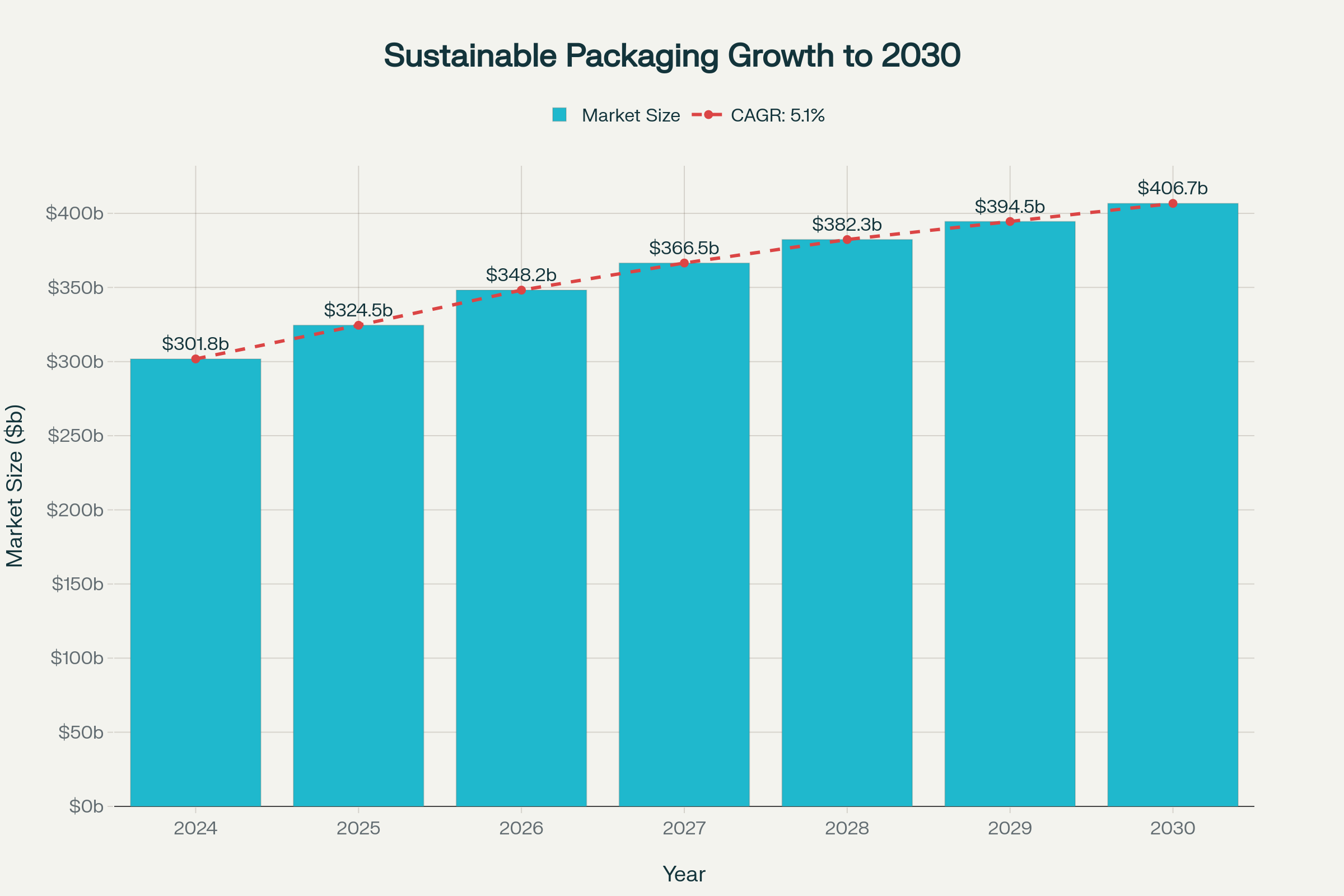
Sustainable Food Packaging Market Projection: 2024-2030
Sustainable packaging isn't monolithic. Each material class carries distinct cost, compliance, supply-chain, and operational trade-offs. Here's how to think about each option through a procurement decision-maker's perspective:
Why it matters: Paper-based packaging is the lowest-risk, fastest-to-deploy option for most food applications. The Asia Pacific region controls 38% of the global paper packaging market, creating dense, competitive supply chains particularly in China, India, and Vietnam. Lead times are typically 3–6 weeks.
Procurement advantages:
High supplier maturity and regional availability reduce single-source risk
Meets EU Grade B (80%) recyclability targets with minimal debate
Existing recycling infrastructure in most developed markets (58% recycling rate in EU)
Equipment modification costs are moderate; most high-speed lines require thermal adjustments only
Procurement risks:
Unit cost premium of 15–20% requires initial margin negotiation with brand teams
Moisture barrier performance demands tight environmental controls (humidity <60%) in warehouses and retail
Printing compatibility varies; specialty inks may carry additional costs
Deforestation narratives can undermine brand messaging if sourcing transparency isn't airtight
Operational reality: Paper works beautifully for dry goods (cereals, grains, snacks), bakery items, and fast-turnover products with <3 month shelf life. For moisture-sensitive or long-shelf items, coatings (often PEF or cellulose-based) are required, adding cost and complexity. Cross-company case data shows paper-based transitions reduce packaging waste by 40–50% and carbon footprint by 30–35% vs. traditional plastic.
Why it matters: Single-material barrier films represent the highest-growth segment in sustainable packaging innovation. Unlike multi-layer laminates (which are recycling nightmares), mono-material structures use advanced coating technologies (EVOH layers, MDO-PE) to achieve oxygen and moisture barriers within a single polymer type, making them recyclable in standard LDPE or PP streams.
Procurement advantages:
Recyclability is Grade A/B (80–95%), meeting long-term EU mandates
Unit cost premium only 8–12%, lower than compostable alternatives
Equipment compatibility is excellent; standard 130–150°C sealing works across most lines
Supply chain is consolidating toward regional production; time to market is 4–8 weeks
Logistics simplicity: single-stream recycling dramatically reduces sorting failures
Procurement risks:
Still emerging in some food categories; supplier base is smaller than traditional multi-layer
Performance data is newer; long-shelf-life validation (>12 months) is still being accumulated
Temperature sensitivity for high-heat applications (retort-sterilization >115°C) requires case-by-case validation
Barrier performance variance across suppliers requires strict incoming quality checks
Operational reality: Mono-material PE/PP is ideal for stand-up pouches, flow-wrapped trays, and flexible packaging for ambient or chilled foods. Brands like Nestlé and PepsiCo are rapidly scaling mono-material trials for juice, yogurt, and snack categories. Procurement teams report that supply chain and recycling infrastructure maturity are 18–24 months ahead of compostables, making mono-material the lowest-risk premium option for most procurement teams in 2025–2026.
Why it matters: PLA (polylactic acid) commands 36.4% of the $2.1 billion compostable plastics market, making it the dominant bio-based option. However, compostables carry unique procurement and operational complexities that many teams underestimate.
Procurement advantages:
Strong brand narrative and consumer recognition ("plant-based," "from corn," "biodegradable")
Regulatory advantage in markets with strong composting infrastructure (some EU regions, Canada)
Certification pathways are clear (EN13432 Europe, ASTM D6400 USA, BPI standards)
Procurement risks:
Unit cost premium of 20–30% is the highest of viable options
Equipment compatibility severely limited: PLA cannot withstand >50–55°C without deformation, ruling out hot-fill applications and retort-processing
Critical infrastructure dependency: PLA only decomposes in industrial composting facilities; home composting doesn't work. If your regional market lacks composting infrastructure, PLA is economically and environmentally pointless
Supply chain is fragmented; lead times stretch to 6–10 weeks
Global compostable certification is still inconsistent; FDA and LFGB compliance requires case-by-case validation
Operational reality: PLA works for ambient, ambient-refrigerated, or cold-chain products with minimal heat exposure—think yogurt cups, deli containers, ready-to-eat salads in markets with industrial composting. However, Gartner's 2025 research found that 90% of public compostable commitments will remain unmet by end-2025, largely because companies underestimated the composting infrastructure gap. Procurement teams should pilot PLA only if your target market has mapped composting facilities with verified processing capacity.
Why it matters: Recycled content is the fastest-to-market, lowest-cost-premium option, with a 5–10% unit cost premium and supply chains that are literally global (58% of EU paper and cardboard is recycled, 39% of plastic).
Procurement advantages:
Meets Grade A (95%+) recyclability immediately
Equipment compatibility is identical to virgin plastic (same thermal properties)
Supply is maturing globally; time to market is 2–4 weeks
Unit cost premium is lowest: 5–10%, sometimes offset by supply diversity that hedges oil-price volatility
Regulatory compliance is straightforward; recycled content is explicitly favored under EU EPR and Canada's bans
Procurement risks:
Quality variance across recycled feedstock suppliers requires rigorous incoming inspection and supply redundancy
Recycled content alone doesn't address the "throwaway culture" narrative; you're improving a linear system, not closing the loop
Traceability and certification (post-consumer vs. post-industrial) add complexity; multiple third-party verification schemes create compliance overhead
Supply chain for food-contact recycled plastic still faces some regulatory scrutiny in certain jurisdictions (FSANZ in Australia, some EU member states)
Operational reality: Recycled content is the pragmatic first move for procurement teams facing cost pressure and short timelines. It's lower-risk than compostables, faster than paper transitions, and demonstrably compliant with evolving regulations. Many brands are using recycled content as a 18–24 month bridge while they develop mono-material or paper roadmaps. Cross-industry data shows brands combining 50% recycled content with 50% virgin material see cost stabilization and regulatory breathing room.
Unit price is misleading. Here's the realistic TCO model that procurement teams should be running:
Eco-Friendly Options: 100–130% of virgin plastic
Drivers: Bio-based or recycled sourcing, less-established supply chains, certification overhead
The gap is narrowing as scale increases. Paper and recycled content are converging toward cost parity (105–115%) by 2026.
Eco-Friendly: 15–20% of total procurement investment
Traditional Plastic: 0% (existing infrastructure)
This is where many procurement teams underestimate. Switching from PET to PLA requires cooling systems upgrades; moving to paper requires humidity controls and thermal profile adjustments. Budget 8–12 weeks for validation and line optimization.
Eco-Friendly: 20–40% of traditional plastic
Traditional Plastic: 100% (baseline, rising 10–15% annually due to landfill taxes)
This is the hidden cost savings that materialize within 6 months. Recycled and compostable packaging often qualifies for fee reductions or subsidies in regulated markets.
Eco-Friendly: 10–15% (proactive certification)
Traditional Plastic: 30–40% risk exposure (growing as regulations tighten)
Non-compliance costs are not linear; one failed shipment can trigger market exclusion, recalls, and reputational damage worth millions. Quantifying this as a percentage is conservative.
Eco-Friendly: 15–25% (diversified sourcing, stable bio-based pricing)
Traditional Plastic: 40–50% (oil price tethered, geopolitical supply risk)
Oil prices have historically swung 30–60% annually; food brands are increasingly modeling sustainable materials as a hedge against petroleum volatility.
Bottom line: The all-in TCO advantage of sustainable materials emerges at months 3–6 and compounds over years. Procurement teams that model only unit cost will make suboptimal decisions; those that model full TCO across 3–5 years see 12–25% total savings.
Rather than a simple matrix, here's a phased decision model that accounts for real-world constraints:
Before material selection, map five dimensions:
Target geography: Which markets must you serve? (EU = mandatory Grade B by 2030; US = softer guidelines; Asia = emerging patchwork)
Product category: Hot-fill, retort, ambient, chilled, or frozen? (PLA fails hot applications; paper needs moisture barriers)
Shelf life: <3 months, 3–12 months, or >12 months? (Longer shelf life demands multi-layer or barrier coatings, complicating sustainability)
Current supply chain: Single-region or multi-region sourcing? (Asia-based teams have faster paper access; European teams benefit from recycled content density)
Brand positioning: Premium, mainstream, or value? (Premium brands can justify PLA narrative; value brands need lowest TCO)
Using the five dimensions, score each material option against your constraints. For example:
EU manufacturer, 6-month shelf-life, ambient product: Paper-based or Mono-material PE/PP are optimal (3–8 week timelines, Grade B compliance, moderate cost)
North American brand, chilled/refrigerated, sustainability messaging priority: Recycled PET or Mono-material PE/PP (cost 5–12% premium, 2–4 week timeline, strong narrative)
Asian brand, ambient-to-chilled, cost-sensitive, no mature local recycling: Paper-based (regional supply advantage, 3–6 week timeline, ~15% cost premium)
Premium brand, short shelf, strong composting infrastructure in target market: PLA trial (but pilot with <20% SKU mix to limit risk)
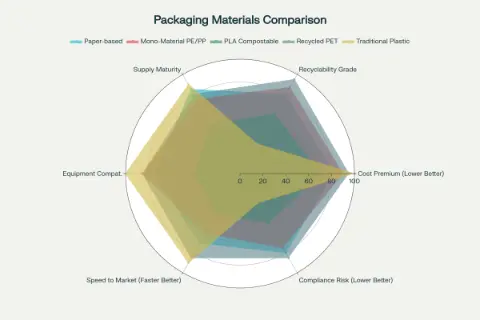
Sustainable Packaging Materials Procurement Scorecard: Multi-Dimension Comparison
Once you've shortlisted materials, engage 3–4 suppliers for each material type. Key vetting criteria:
Regulatory certification: EN13432, ASTM D6400, FDA, LFGB, or local equivalents
Supply chain transparency: Can they trace back to feedstock source? (Critical for compostables and recycled content)
Lead time consistency: Do they meet 3–4 week commitments 90%+ of the time?
Quality control: What's their defect rate for food-contact applications? (Industry benchmark: <0.5%)
Scalability: Can they grow with your volume, or will you hit supply ceilings?
For Asia-based procurement (paper, recycled content), validate that suppliers have regional certifications and can handle both local and export compliance.
Run small-batch trials on your existing packaging lines:
Print trials: Verify that inks adhere correctly to new substrates
Performance testing: Moisture barrier, gas transmission, seal strength, temperature cycling
Line optimization: Identify thermal, pressure, and speed adjustments needed
Compliance lab testing: Confirm food contact safety and recyclability/compostability against target standards
This phase is critical. Many procurement teams skip it and hit problems at scale, forcing costly line shutdowns.
Once pilots validate, negotiate volume contracts. Key points:
Price locks: Sustainable materials can be volatile; lock raw material prices for 12–24 months if possible
Volume rebates: Can the supplier reduce premiums at higher volumes? (Realistic: 2–3% reduction per 25% volume increase)
Supply redundancy: Identify backup suppliers for each material to mitigate single-source risk
Compliance co-ownership: Build audit and certification tracking into the supplier contract; failures cascade quickly
A multinational quick-service restaurant chain faced retailer pressure to eliminate plastic clamshells for salads and prepared foods. Their decision journey:
Challenge: Paper-based alternatives in warm/humid retail environments showed moisture penetration after 4 hours, ruining product presentation.
Solution: Switched to PE-coated kraft paper (single-layer, recyclable as fiber) and optimized storage humidity to <55% at point-of-sale. Cost premium: 12% per unit.
Results: Within 6 months, waste reduction of 72% across 500+ outlets, inventory costs down 15% (less shrinkage from moisture damage), retailer compliance achieved ahead of EU 2030 deadline, secured green subsidy of €0.02–0.03 per unit from regional waste authority.
Procurement takeaway: Regional supply chain knowledge (understanding humidity and logistics) was more valuable than material technology itself. Lead time to compliance was 4 months (faster than expected) because the team engaged suppliers early and ran dual-track trials.
A European dairy brand needed to transition yogurt cups from multi-layer PET/PE/EVOH to mono-material without sacrificing 12-month ambient stability claims.
Challenge: Mono-PE with EVOH coating met recyclability Grade A but showed oxygen permeation risk at 10+ months for some SKUs.
Solution: Adopted mono-PE + nanoclimate EVOH barrier (certified single-material under EU 2030 thresholds), increased cup wall thickness by 0.1mm, and validated shelf-life claims in independent labs. Cost premium: 8% per unit.
Results: Achieved Grade A (95%+) recyclability, recycling infrastructure adoption at 67% across target countries within 12 months, brand trust scores increased 18% (verified via consumer survey), supply chain simplified from 6 suppliers to 3.
Procurement takeaway: Lead time from concept to scaling was 8 weeks (vs. 14 weeks for compostables) because single-material infrastructure is more mature. The team's biggest risk was overconfidence; they initially underestimated the need for independent lab validation, which added 3 weeks but prevented market failures.
A premium organic brand committed publicly to "100% compostable" packaging by end of 2024. They selected PLA for all product lines.
Challenge: Only 3 of their 12 target markets had certified industrial composting facilities. In remaining markets, PLA ended up in landfills (where it doesn't biodegrade), creating a brand trust crisis when consumers and NGOs publicized the gap.
Results: Brand reputation damage, forced shift to alternative materials mid-supply-chain, cost overruns of 23% due to expedited re-tooling, delayed product launches.
Procurement takeaway: Infrastructure maturity is non-negotiable for compostables. This brand learned the hard way that supply-side innovation (material availability) and demand-side infrastructure (end-of-life facilities) must move in lockstep. Their recovery strategy: PLA for markets with verified composting (EU, Canada), recycled PET for North America, paper for emerging markets—a regional mixed portfolio that is now working.
In 2025, packaging procurement is becoming a competitive moat. Teams that move decisively on sustainable materials early gain leverage on:
Retailers are scorecarding suppliers on sustainability. Brands that achieve >80% recyclable packaging 12–18 months ahead of regulation enjoy preferential placement and promotional support. For fast-moving consumer goods (FMCG) brands, shelf placement premium can translate to 10–15% incremental sales volume.
Brands using diversified material suppliers (paper + recycled + mono-material) and regional sourcing (Asia + Europe + local) show 40–50% lower cost volatility than those tethered to single oil-price-linked suppliers. Procurement teams that build supply redundancy today are insulated against geopolitical and commodity shocks tomorrow.
Transparent, verifiable sustainability claims are increasingly linked to brand loyalty and willingness to pay. Brands that can communicate specific material changes ("now 95% recyclable," "compostable in regional facilities") see 5–12% uplift in brand trust scores, translating to less promotional discounting needed.
Early movers on compliance (achieving Grade B or A recyclability 12–24 months before regulatory deadlines) gain operational flexibility and avoid costly last-minute scrambles that plague late adopters. Procurement teams are reporting 20–30% cost premiums for expedited material switches vs. planned transitions.
Sustainable packaging procurement in 2025 is not about choosing between cost and compliance. It's about understanding that compliance IS cost management, and that early, strategic procurement decisions compound competitive advantage over 3–5 years. The brands and retailers that execute decisively now on material transitions will control shelf space, consumer preference, and regulatory risk by 2027.
Your immediate action: Map your SKU portfolio against regulatory deadlines by geography, select 2–3 material pilots that align with your supply chain capabilities, and lock in 12–18 month supplier partnerships today. The cost premium you negotiate today will be offset by waste fee savings, regulatory compliance, and market access premiums within 6–18 months.
The market is moving. The question isn't whether to transition—it's whether you'll lead or follow.
Contact: LTC Bagging System
Phone: +8613337332946
E-mail: [email protected]
Add: Wenzhou, Zhejiang Province, China