
It’s not science fiction — it’s happening right now.
According to recent data, the global food packaging robot market has grown from $7.5 billion in 2024 to $7.6 billion in 2025, and is expected to reach $22 billion by 2034.
That’s not just a number — it represents a deep transformation in the entire industry.
And here’s the thing: this transformation is happening faster than you might think.
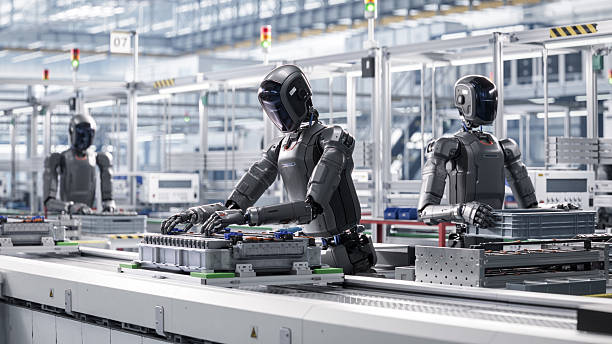
Maybe you’re still using traditional automation — machines that work hard, but only perform repetitive motions.
But the real shift has already begun.
Collaborative robots (Cobots) are changing the game. Unlike traditional industrial robots that must be fenced off to protect workers, the new generation of cobots can work safely side by side with humans.
They’re equipped with force and proximity sensors that slow or stop the machine the moment a person gets too close.
Even better, these robots are designed for food environments — made of stainless steel, smooth and seamless, easy to clean, and fully compliant with FDA and EU hygiene standards.
That means they can boost efficiency while meeting the strictest food safety requirements.
Now, add AI and machine learning — and the game changes completely.
Imagine you have a worker who’s been on the line for ten years.
He can sense when a package looks off, when a seal isn’t quite right, or when a product batch needs adjustment. That intuition is valuable.
But there’s a problem:
He gets tired.
He loses focus.
He might leave.
And you can’t easily replicate his skills.
AI solves this problem.
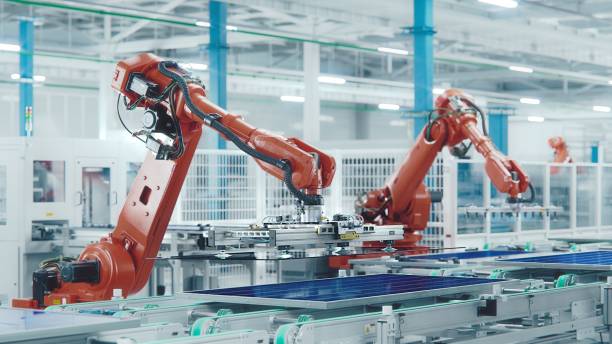
For example, Coca-Cola uses AI to scan barcodes — and when it detects wear or misalignment, the system automatically adjusts the packaging process, reducing the need for human intervention.
AI can also analyze product characteristics — size, shape, color — and suggest the most efficient way to pack them.
Through reinforcement learning, robots can learn how to optimize space or adjust movements when handling irregular items like vegetables or baked goods.
Do you know how high the human inspection error rate is? Around 50%.
That means half the defects could go unnoticed.
AI-powered vision systems, however, can simultaneously detect and classify multiple types of defects — sealing errors, label misalignment, smudges, barcode issues, print quality, dents, tears, or contamination — all in real time.
More importantly, these systems don’t just detect flaws — they log and categorize them for root-cause analysis and process improvement.
So you’re not just rejecting bad products — you’re learning how to prevent future issues.
One food manufacturer who implemented automated visual inspection saw a 90% reduction in product damage, saving about €15,000 per month in lost goods.
Equipment failure is every packaging plant’s nightmare.
A single hour of downtime can cost between $10,000 and $30,000.
But what if you could see problems coming before they happen?
AI-based predictive maintenance does exactly that:
Sensors collect operational data from filling, sealing, or labeling machines.
AI analyzes the data in real time and flags irregular patterns.
When it detects early signs of wear or failure, the system alerts maintenance staff.
You can schedule repairs proactively — not reactively.
The result? 30–50% less downtime.
For example, in a production line using MarCoPack labeling machines, AI can detect subtle changes in conveyor speed or power use — and recommend cleaning or part replacement before performance drops.
This might be the most exciting development.
Traditional packaging lines require up to 30 minutes of downtime to switch products.
But new adaptive robotic systems can change on the fly.
How? Through smart grippers, AI-driven path planning, and flexible tool changers.
A single machine can handle different product sizes and shapes — from grapes to tomatoes, from snack packs to large boxes.
Some systems even use 3D cameras and multispectral imaging to assess product quality and shape, then automatically adjust how each item is packed — like the robot has learned to “customize” its approach.
In practice, this means less downtime, more product variety per line, and faster response to market demand.
You no longer need multiple dedicated lines for different SKUs.
Remember the 2024 news from Chipotle?
They tested the Autocado robot in California — it can slice an avocado in 26 seconds — along with an automated meal-assembly system that builds bowls.
This highlights an important shift:
Robots aren’t replacing people — they’re taking over the dull, dirty, and dangerous tasks so humans can focus on higher-value work.
In packaging, cobots can handle standard tasks like case packing, palletizing, and labeling, while people focus on supervision, troubleshooting, and quality checks.
The result? More fulfilling jobs and 15% fewer workplace injuries.
Numbers don’t lie.
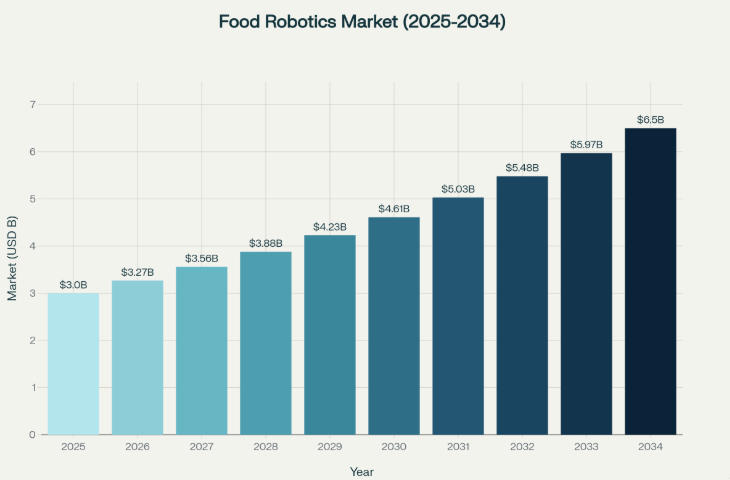
The global food robotics market hit $3 billion in 2025 and is expected to reach $6.4 billion by 2034, growing at a CAGR of 8.9%.
In the U.S., growth is even faster — from $714 million in 2025 to $2.7 billion by 2034, a CAGR of 16%.
And the packaging robotics segment? Even stronger — $7.5 billion in 2024 to $22 billion by 2034, with an 11% CAGR.
Labor shortages. Every country is struggling to find workers — especially in food manufacturing, where conditions are tough and turnover is high.
Stricter food safety regulations. Automation helps companies meet consistent quality and hygiene standards.
Growing demand for packaged and ready-to-eat foods. Post-pandemic consumers want convenience and safety, driving higher packaging throughput.
Let’s be honest — every new technology comes with its challenges, and AI + robotics in packaging are no exception.
43% of small and medium-sized manufacturers say high upfront cost is the main barrier to automation.
A full adaptive packaging system can cost between $150,000 and $500,000, which is significant for smaller businesses.
But here’s the secret: modular systems are changing the game.
You don’t have to automate everything at once. Start small — maybe automate label inspection or seal verification first.
Then expand gradually, achieving ROI faster with each step.
Once you connect machines to the internet, hackers can listen in.
IoT devices can be entry points for attacks or data leaks.
The good news? There are solid solutions.
Using AES-256 encryption, secure protocols like LoRaWAN or Zigbee, and regular security audits drastically reduce the risk.
Choosing a supplier who understands these security challenges is essential.
At LTC Bagging System, we take this seriously — your data safety is part of your business safety.
Even the best system fails if your team doesn’t know how to use or maintain it.
Most implementation failures are caused not by technology — but by people.
That’s why it’s vital to choose a supplier with strong after-sales service and comprehensive training — from installation and calibration to operator education and maintenance support.
Here’s the truth: food products vary wildly — in size, shape, and texture.
How can one machine handle soft bread, hard biscuits, and delicate vegetables equally well?
That’s a legitimate technical challenge.
Soft-gripping robotic hands are improving quickly, but more innovation is needed before we achieve full flexibility.
Imagine being able to test every production line change — virtually — before you ever touch a machine.
That’s what digital twin technology is making possible.
A leading manufacturer used digital twins to map its entire line, tracking every unit’s journey through production.
By identifying bottlenecks and optimizing flow, they cut total processing time by around 4%.
For food packaging, this means you can experiment with new products, layouts, or workflows without interrupting production.
Not all data should go to the cloud.
At speeds of 600 bottles per minute, inspection systems have less than 100 milliseconds to capture, analyze, and decide.
Even tiny delays in cloud transmission can wreck efficiency.
Edge computing fixes this.
Data is processed locally — directly on the machine.
Images are captured, analyzed, and decisions made within milliseconds, while only summary reports are sent to the cloud.
That keeps systems fast, reliable, and efficient.
Imagine a package that can tell its own story.
With blockchain and IoT sensors, full supply-chain transparency from farm to consumer is becoming real.
For the food industry, this means:
Total transparency — consumers can see where their food comes from.
Faster recalls — pinpoint exactly which batches are affected.
Anti-counterfeiting — blockchain’s immutability makes tampering nearly impossible.
This isn’t a “future problem.”
It’s a present-day advantage.
Your competitors — whether it’s honorpack.com or all-fill.com — are already investing in AI and robotics.
Early adopters are gaining higher efficiency, lower costs, and superior quality — giving them more capital for R&D, marketing, and expansion.
We’re still in the early adoption phase of this technology.
That means the companies that move now could hold a massive competitive edge by 2028.
The market will keep growing at 8–16% annually — but the biggest rewards will go to those who master it first.
Not every line needs a full rebuild.
Start where the pain is greatest:
High defect rate?
Low efficiency?
Rising labor costs?
Long changeover times?
Don’t try to automate everything overnight.
Pick a low-risk, high-impact pilot project, such as:
Adding computer vision inspection to one product line
Introducing a collaborative robot at a key workstation
Implementing AI-based predictive maintenance for one machine
Test, learn, refine — then scale.
Choose a partner who truly understands the food packaging industry — one who can deliver end-to-end solutions, not just sell hardware.
At LTC Bagging System, we specialize in food packaging automation.
We know your unique challenges — from hygiene to flexibility, from safety to cost efficiency.
We don’t just sell machines — we build complete ecosystems of suppor: consulting, design, installation, and long-term optimization.
As you adopt these technologies, having a data governance framework is crucial.
Decide:
What data to collect
How to secure and store it
Who has access
How to use it for continuous improvement
A solid data strategy helps you:
Optimize faster
Detect issues earlier
Forecast and plan better
Tell a more compelling story to investors and customers
Here’s the truth: it’s not about if you’ll adopt AI and robotics — but when and how.
Some companies will wait and watch.
But the market won’t wait.
By 2028–2030, those who start today will already have:
Gained competitive advantages
Recovered their investments
Optimized their operations
Accumulated real-world experience
And those who hesitate will find themselves left behind.
So ask yourself — which kind of company do you want to be?
If you’re ready to explore how AI and robotics can transform your packaging line, let’s talk.
Whether you’re just exploring, piloting, or planning a full deployment, our team is ready to guide and support you.
The future of food packaging is being built right now.
The only question is: will you shape it — or be shaped by it?
Contact: LTC Bagging System
Phone: +8613337332946
E-mail: [email protected]
Add: Wenzhou, Zhejiang Province, China