
For most food granules sold in retail pouches between roughly 100 g and 1 kg, the strongest default is a rotary multihead weigher mounted above a vertical form fill seal machine: granules flow freely, so weighing each dose beats dosing by volume, and the VFFS format keeps film cost per bag low. Choose a premade pouch machine instead when the bag itself is the selling point, meaning zippers, quad seals or shelf-ready flat bottoms. Choose an open-mouth net weigher when you sell 10 to 25 kg sacks. Below, the five machine types are compared across a decision table, eight buying dimensions and cost breakpoints, so you can place your product on the right row instead of guessing.
Key takeaways
Granules are free-flowing, so accurate dosing means weighing, not volumetric filling; cups are the budget exception.
The bag format decides more than the product does: pillow pouch pushes you to VFFS, zipper and quad-seal formats push you to premade pouch.
Multihead weighers buy speed through redundancy: many heads weighing in parallel, best combination wins.
Linear weighers are the mid-speed compromise when a multihead is more machine than the volume needs.
Bulk sacks are a different machine family entirely: net weighers filling open-mouth bags, not pouch machines.
Run the labor-and-giveaway arithmetic on your own numbers before comparing quotes; machine price is the smaller half of the decision.
| Your situation | Machine type that fits | Why |
|---|---|---|
| Rice, sugar, snacks; pillow or gusseted pouches; 30 to 80 bags/min | Multihead weigher + VFFS | Weighing accuracy at high speed, lowest film cost |
| Same products, 10 to 30 bags/min, tighter budget | Linear weigher + VFFS | Fewer heads, simpler control, easier maintenance |
| Uniform granules, one dose weight, entry-level volume | Volumetric cup filler | Cheapest dosing; accuracy depends on consistency |
| Zippers, quad seal, flat-bottom, stand-up premium packs | Premade pouch machine + weigher | The bag already exists; machine fills and seals it |
| 10 to 25 kg sacks of rice, sugar, feed, seeds | Open-mouth net weigher + bagger | Made for bulk weights, stitched or heat-closed mouths |
If you only remember one row: product decides the dosing, bag decides the machine.
1. Volumetric cup filler. A rotating disc of calibrated cups scoops product, and every cup equals one dose. Accuracy lives or dies on product consistency: uniform granules like white rice dose well, while mixed products shift density from cup to cup. It is the least expensive entry into automated granule packing and the least accurate of the five.
2. Linear weigher. One to four weigh buckets sit above the bagger. Product vibrates into the buckets, each bucket reports its weight, and the controller releases the best single bucket or combination. Slower than a rotary multihead but far more accurate than cups, and the step-up cost is modest. This is the sweet spot for mid-volume lines that still want weighed doses.
3. Rotary multihead weigher. Ten to fourteen heads circle a central cone, each filling a weigh bucket every cycle. The controller picks the combination of buckets closest to target, which is why accuracy improves with head count: more buckets means more possible combinations. Mounted above a VFFS machine it sustains 30 to 80 bags per minute on snacks, granola, rice and pet food. On a granule VFFS packaging line, the weigher is the accuracy engine and the bagger is the speed engine.
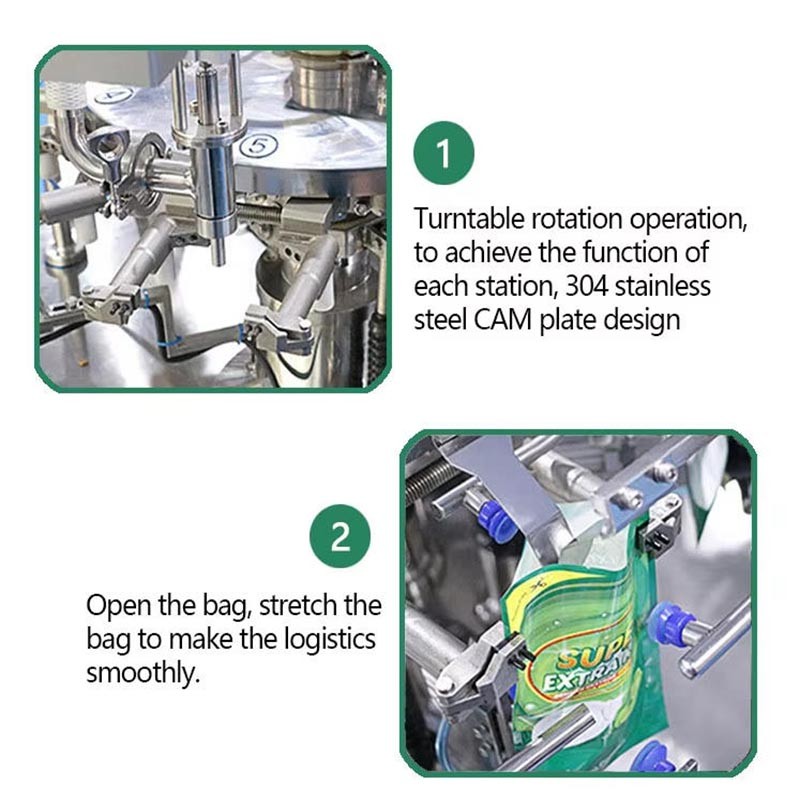
4. Premade pouch machine. The bags arrive pre-formed, often with zippers or spouts already installed. A rotary machine grips each pouch, opens it, flushes it with nitrogen if needed, fills it from a weigher above, then seals. Cycle rates sit below VFFS speeds, but the finished pack justifies that on premium shelves. The trade is real: you pay more per bag for pre-made pouches and gain formats a VFFS cannot form.
5. Open-mouth net weigher. For bulk, product fills a net-weighing hopper to the target, then discharges into a clamped sack. Weights from 5 kg upward, coarse accuracy tolerances, and integration with stitching or heat-closing systems. No retail pouch involved at all.
The through-line: types 1 through 3 dose into film they form themselves, type 4 fills bags someone else formed, type 5 abandons pouches for sacks.
| Dimension | Cup filler | Linear weigher | Multihead + VFFS | Premade pouch | Open-mouth net |
|---|---|---|---|---|---|
| Dosing principle | Volume | Weighed, few buckets | Weighed, many buckets | Weighed above machine | Net weighed in hopper |
| Speed band | Moderate | Moderate | High | Low to moderate | Sack-paced |
| Accuracy expectation | Loosest of the five | Solid | Strongest | Strong | Coarse by design |
| Bag formats | Pillow, simple gussets | Pillow, gussets | Pillow, gussets, quad on some models | Zipper, spout, flat bottom, stand-up | Woven or laminated sacks |
| Format flexibility | Low | Low to medium | Medium | Highest | Sack sizes only |
| Packaging material cost | Lowest, rollstock | Lowest, rollstock | Low, rollstock | Highest, pre-made pouches | Sack cost per kg favorable |
| Footprint and structure | Compact, simple frame | Compact | Taller, weigher deck above bagger | Compact rotary or linear | Heavy frame, floor-loaded |
| Changeover effort | Swap cups, quick | Recipe change | Recipe change, vibration tuning | Gripper and recipe change | Sack clamp and recipe change |
Read the table column by column when shortlisting, and row by row when two quotes fight each other.
Machine price differences are easy to see; total cost differences hide in three lines that deserve your own arithmetic.
Material per bag. Rollstock-fed types (1 to 3) buy film by the kilogram and print centrally; premade pouches (4) carry a per-unit premium that scales with format complexity. Multiply the pouch premium by your annual bag count before falling in love with a flat-bottom format. Our granule packaging solutions page groups machine options by product so you can sanity-check the pairing.
Giveaway. Weighed dosing beats volumetric dosing, and the gap is worth grams per thousand bags. The arithmetic: one gram of giveaway on a 250 g pack is 0.4 percent of product cost, every bag, all year. In one snack case study we documented, moving from manual weighing to an automated weighing-and-sealing system narrowed bag weight deviation from ±8 g to ±2 g and cut seal failures from 3 to 5 percent per batch to under 1 percent, details in the snack packaging consistency case study. Run the same calculation on your declared weight and current deviation.
Labor per line. Manual bagging crews cost shift wages times shifts times years; automated lines convert that into one or two operators. The honest comparison counts rework and QC time, not just filling labor, because inconsistent manual output bills downstream.
A workable breakpoint habit: estimate bags per day, multiply by material and giveaway differences, and see which machine family the annual number favors. Treat every supplier quote as confirming evidence for your own model, never as the model itself, and confirm current prices and lead times with each supplier directly.
VFFS wins on cost per bag, but three situations flip the decision.
First, the resealability requirement. A zipper cannot be formed on a VFFS tube; it arrives built into a premade pouch. If your category expects reclosure, protein snacking, granola, premium rice blends, the premade route is not a luxury, it is table stakes.
Second, the flat-standing shelf pack. Flat-bottom and quad-seal bags hold their shape on shelf and print five panels. Brands competing on shelf presence pay the pouch premium willingly because the bag is doing merchandising work.
Third, low-volume, high-mix production. Premade pouch machines change formats by recipe and gripper set, with no film threading. Lines running many SKUs at modest volumes often lose more to VFFS changeovers than they save on film.
For dense products like coffee beans the format argument compounds, which is why quad-seal coffee bags have their own following; our quad seal bag explainer covers why that format holds heavy beans so well.
The pattern we encounter most often: a buyer picks a machine for today's product and today's volume, then adds a second product family and discovers the dosing or the format was the wrong bet. Three concrete traps recur.
Buying cups for a product roadmap that includes mixed granola. Cups assume consistent density; mixed product with clusters and flakes does not have any. The money saved on dosing comes back as giveaway and manual re-checks.
Buying a multihead when the volume never arrives. Redundant heads pay off through speed and combination choice; a line that runs three hours a day does not exercise either. The linear weigher was the honest fit, and its maintenance is simpler.
Specifying the machine before the bag. Format decisions, zipper or not, pillow or flat-bottom, printed or plain, cascade into machine choice, material cost and changeover time. The bag is the spec; the machine implements it.
A fourth, quieter mistake: comparing quotes on machine price while ignoring integration, metal detector mounting, nitrogen flushing, support and spares. Ask each supplier to price the line, not the hero unit, and to state accuracy on your actual granule, in writing.
For modest volumes with varied SKUs, a linear weigher above a compact VFFS, or a premade pouch machine if the formats are premium, usually fits better than a multihead line. The decision table above places your product; the cost section turns it into numbers.
A multihead selects the best bucket combination each cycle, which is why it holds tighter tolerances than volumetric cups on the same product. Exact bands depend on the granule, dose weight and line speed; treat quoted accuracy as a hypothesis until your product runs on the proposed configuration, and confirm the guaranteed figure with the supplier.
Not on a VFFS alone, because zippers cannot be formed on the tube. The common answer is a VFFS for volume SKUs plus a premade pouch machine for premium SKUs, or a premade pouch machine alone if zipper formats dominate the range.
Speed depends on dose weight, weigher heads and product behavior. Multihead-fed VFFS lines commonly run in the 30 to 80 bags per minute band for retail granule doses; heavier doses and slower-settling products pull the number down. Ask for demonstrated speeds at your dose weight, not catalog maximums.
Most retail and export customers expect inline metal detection, and a checkweigher closes the quality loop by catching drift as it happens. Both mount between weigher and outfeed on a well-planned line; specify them at purchase so integration is clean rather than retrofitted.
Not sure which bagging setup fits your product and output target? Send us your product details, bag format and target speed, and get a machine recommendation and quote.
Contact: LTC Bagging System
Phone: +8613337332946
E-mail: [email protected]
Add: Wenzhou, Zhejiang Province, China