
Powder packaging lines are built around one decision before any other: the dosing principle that moves product from hopper to bag. Two principles dominate. The auger filler meters powder volumetrically, a rotating screw pushing a fixed volume per turn, and handles powders that refuse to flow by themselves. The net weigher doses gravimetrically, vibrating or belt-feeding product into a bucket on a load cell until the target weight is reached, and suits powders that flow freely. Neither is better in general; the powder itself votes. Five factors decide: flowability, dose size, accuracy requirement, speed class and dust behavior. Each is below, with the hybrid configurations that combine the strengths of both.
Key takeaways
Auger fillers meter volume per screw turn and suit non-free-flowing powders, flour, cocoa, milk powder blends, that bridge and compact in hoppers.
Net weighers meter weight on a load cell and suit free-flowing powders, sugar, salt, grains, at higher doses and higher speed classes.
Flowability is the first factor: a powder that bridges in a hopper starves a net weigher but feeds happily from an agitated auger system.
Dose size is the second: small doses suit the auger's per-turn precision; large bags favor weigh buckets that scale without losing speed.
Auger accuracy is volumetric and drifts with bulk density; net weighers weigh every dose but cost more and run taller. Feedback systems close the gap.
| Your powder | Principle that fits | Why |
|---|---|---|
| Flour, cocoa, starch, blended powders | Auger filler | Non-free-flowing, bridges, needs mechanical metering |
| Sugar, salt, milk powder, instant drinks | Net weigher | Free-flowing, fills buckets cleanly by vibration |
| Small doses, sachets and stick packs | Auger filler | Per-turn volumetric control at small volumes |
| Large bags, 5 kg and up | Net weigher | Weigh buckets hold speed as dose grows |
| Density varies batch to batch | Auger with weight feedback | Volumetric core plus checkweigher correction |
| Highest accuracy spec, audit trail needed | Net weigher | Gravimetric record of every dose |
For the broader powder line around this choice, dust control, film selection and sealing, our guide to bagging powder without dust and weight errors covers the full chain; this article stays on the dosing core.
The auger filler is a screw inside a tube. Product enters from an agitated hopper that keeps it moving into the screw flights; each rotation pushes a fixed flight volume toward the bag. Dose equals turns times flight volume, so the control system counts degrees of rotation. The whole path can be enclosed, which is why auger systems are the dust-tight ones: powder travels inside a tube from hopper to bag instead of falling through open air. The trade-off is that volume is not weight. If bulk density shifts between batches, the same screw turn delivers a different mass, which is why serious auger lines add weight feedback.
The net weigher is a bucket on a load cell. Vibration feeders or belt feeders trickle product into the bucket; the cell reads the weight live; feeding stops at target, the bucket opens and the dose drops into the bag. Multi-bucket versions weigh several buckets per dose and comb the best-fitting combination, which is how they hold tight tolerances at speed. The trade-offs are height, buckets and their cleaning, and the demand that product actually flows to the feeders on its own.
Factor 1: flowability. Scoop the powder and let it settle. If it levels itself and pours like sugar, a net weigher feeds it happily. If it holds a mound, bridges over the hopper outlet or compacts under its own weight, the auger's agitated hopper is not optional, it is the only way the product reaches the dosing point at all. Misreading this factor produces the classic failure: a starved weigher dribbling underweight doses while operators tap the hopper with a mallet.
Factor 2: dose size. Auger precision lives at small to medium doses, where a fraction of a screw turn is a meaningful correction; sachets, stick packs and retail bags are its home ground. Weigh buckets hold their speed as doses grow, because feed time scales with dose weight less steeply than screw turns do, so bulk bags and industrial formats lean net weigher. The crossover sits in the middle ranges, where both principles quote competitively and the other factors break the tie.
Factor 3: accuracy requirement. Ask what the tolerance actually is, in grams or percent, and what the market regulator or retailer audits. A net weigher weighs every single dose, which makes accuracy a direct measurement rather than an inference. An auger infers weight from volume; on stable-density powders that inference is tight, and weight feedback, a checkweigher downstream signalling corrections to the screw count, keeps it there through density drift. Quote the tolerance to suppliers in writing and hold trials to it.
Factor 4: speed class. Count doses per minute at your bag width and fill weight, not catalog maximums. Auger systems run one dose per machine cycle and scale by multiplying lanes, common on stick pack lines. Net weighers, especially combinatorial ones, overlap their weighing cycles and feed high-speed baggers continuously. As a rule, speed pushes toward weighers and multiplicity, accuracy at small doses pushes toward auger lanes.
Factor 5: dust and hygiene. Powder lines are judged by the dust they do not make. The auger's enclosed path is its structural advantage: fewer open transfers, less airborne powder, easier suction point placement. Net weighers run open buckets and free falls, which demands aspiration and more disassembly at cleaning. In food plants where allergen changeovers are scheduled events, count the cleaning time of each option as part of its speed, not an exception to it.
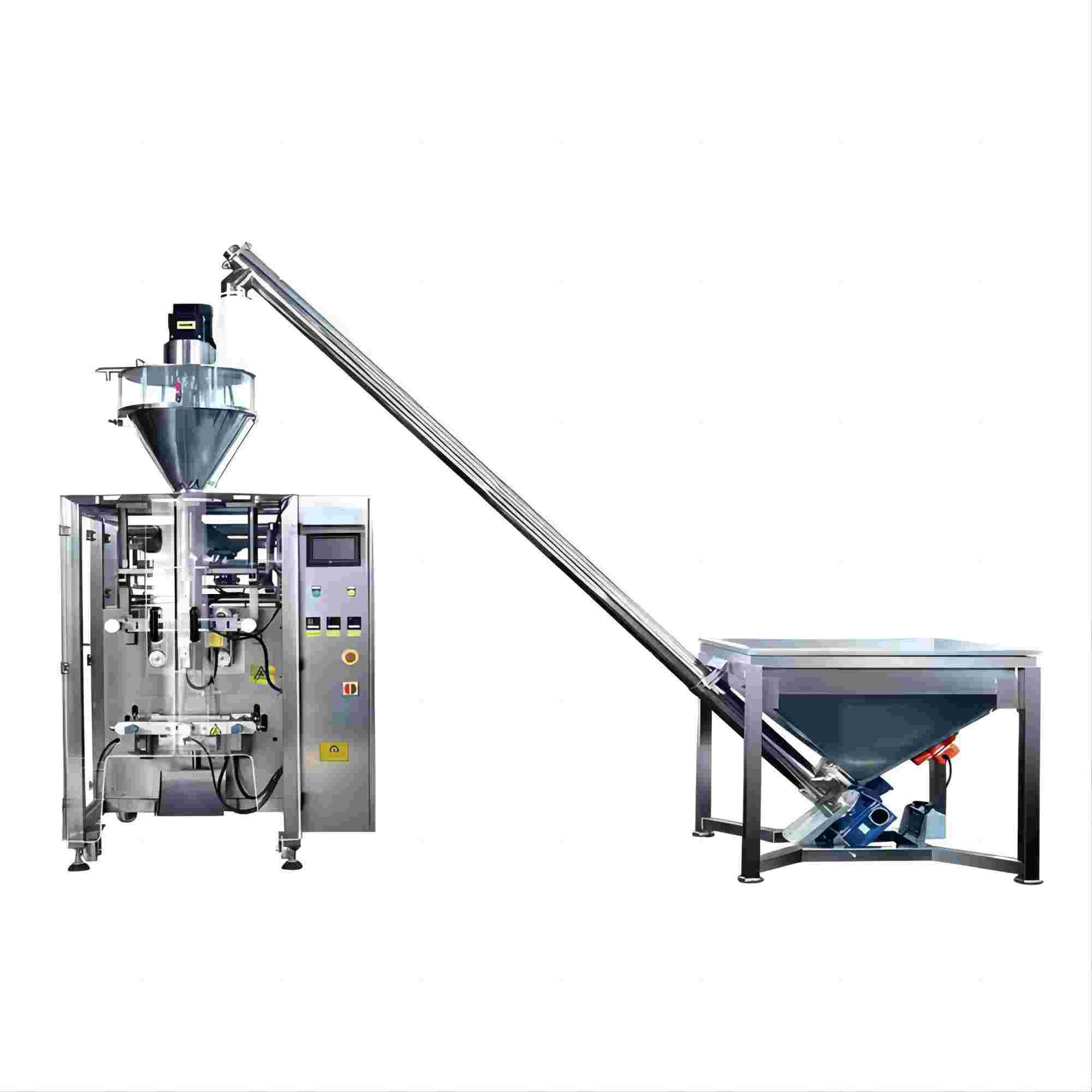
The two are endpoints of a spectrum, and production lines borrow from both ends. Auger lines add checkweighers and feedback loops until their volumetric core behaves gravimetrically. Net weighers add agitation and baffle designs until mildly stubborn powders feed acceptably. Suppliers configure hybrids for specific products, which is why the trial on your actual powder, in your actual bags, at your actual speed, is the only test that matters; indicative figures from a supplier brochure are orientation until confirmed in writing.
Product-specific configurations shorten the search. Flour is the canonical non-free-flowing case, and our flour packing machine page shows the auger-centered line built around it. The powder packaging solutions overview groups configurations by powder family, and one factor upstream shapes the dosing choice too: film and bag material interact with static, moisture and dust behavior, which our practical guide to choosing packaging bag material works through from the product side.
The brochure decides nothing; the trial does. A serious dosing trial runs on your actual powder, not a reference material, because flowability and density are product-specific facts no supplier can simulate. Send two lots if you can, the most bridging lot and the most aerated one, so the system faces both extremes it will meet in production. Specify your real dose weight and bag format, and ask for a run long enough to reach steady state, because first-hour behavior and steady-state behavior differ on any dosing system.
Record three things during the run. First, a sample stream of dose weights, at least thirty consecutive doses at two points an hour apart, which reveals both spread and drift. Second, the corrections the feedback system makes, if feedback is in scope, because a system trimming constantly is telling you the powder varies more than the quote assumed. Third, the dust situation around the machine after an hour, judged by eye and by the wipe test on adjacent surfaces, since dust escaping at the trial will escape in production.
The acceptance criterion should be written before the trial: your tolerance, stated in grams or percent, at your dose weight, sustained over the run, not a demonstration hit on a single bag. Suppliers who configure dosing systems for a living expect exactly this conversation, and the ones who resist it are answering a different question than the one your production line will ask every day afterward.
| Mistake | Symptom on the line | The check before signing |
|---|---|---|
| Net weigher on a bridging powder | Starved doses, operator mallet duty, drifting weights | Flowability test first, Factor 1 before any quote |
| Auger without feedback on variable-density blends | Weight drifts between batches, rework at pallet stage | Specify checkweigher feedback in scope |
| Sizing by catalog maximum speed | Line never reaches quoted rate at your dose | Trial at your weight, bag width and product |
| Ignoring cleaning time between allergens | Changeover eats the shift the speed bought | Disassembly and cleaning demo at the trial |
| Choosing on machine price alone | The cheap dosing core costs a season of rework | Total line economics, waste and labor included |
With feedback, yes, within limits. The auger's volumetric core drifts with bulk density, but a checkweigher downstream measures each bag or a sample stream and trims the screw count continuously. On stable-density powders this closes most of the gap; on blends whose density swings between lots, the weigher's per-dose measurement keeps the advantage.
A dosing system that fills a bucket on a load cell until the target weight is reached, then releases it into the bag. Combinatorial versions weigh multiple buckets per dose and discharge the combination closest to target. It is the gravimetric counterpart to the volumetric auger.
The auger. Flour bridges, compacts and aerates unpredictably, so it must be mechanically conveyed into a metering screw; gravity-fed weigh buckets starve on it unless heavily engineered. Flour lines are the textbook auger case, which is why dedicated flour configurations exist.
Mostly augers, multiplied across lanes. Stick pack doses are small, which suits per-turn screw control, and the multi-lane format scales output by adding dosing lanes rather than speeding up one channel. Free-flowing powders do run on small bucket weighers at the top of the speed class.
The practical tests are enough for the decision: pour it and watch whether it self-levels, let it stand in a hopper shape and see whether it bridges over a small outlet, and compress a sample and see whether it compacts. Any mound-holding, bridging or compacting behavior votes auger; clean pouring votes for either, and then dose size and accuracy decide.
Not sure which bagging setup fits your product and output target? Send us your product details, bag format and target speed, and get a machine recommendation and quote.
Contact: LTC Bagging System
Phone: +8613337332946
E-mail: [email protected]
Add: Wenzhou, Zhejiang Province, China