
Viscosity, measured in centipoise (cP), decides your sauce filling machine more than brand, speed class or price does. Water sits near 1 cP, honey in the low thousands, tomato paste well above that, and each step up that ladder rules out whole categories of fillers. The working method: measure or estimate your sauce's viscosity, place it in one of four bands, then choose the filling principle that band requires, gravity and flow metering for thin liquids, lobe pumps for pourable sauces, piston fillers for thick pastes, piston fillers with particulate handling for chunky products. Format comes second: sachets, spouted pouches and bottles each tolerate different products. Below are the four bands, the filler for each, and the mistakes we see when a sauce runs on the wrong one.
Key takeaways
Viscosity in cP is the first number to establish; everything from filler to nozzle follows it.
Band 1 thin liquids (roughly 1 to 100 cP): gravity or flow-meter filling.
Band 2 pourable sauces (roughly 100 to 5,000 cP): lobe pump or time-pressure filling.
Band 3 thick pastes (roughly 5,000 to 100,000 cP): positive-displacement piston filling.
Band 4 pastes with particulates: piston filling with particulate valves, bottom-up nozzles and an agitated hopper.
Handbook cP values are orientation only; sauces are non-Newtonian, so confirm with your own measurement and a supplier trial on your actual product.
| Band | Typical product | Filling principle | Formats that suit |
|---|---|---|---|
| 1 Thin, free-flowing | Vinegar, soy sauce, thin hot sauce | Gravity or flow meter | Sachet, pillow pouch, bottle |
| 2 Pourable sauce | Syrup, dressing, BBQ sauce | Lobe pump or time-pressure | Sachet, premade pouch, bottle |
| 3 Thick paste | Ketchup, honey, tomato paste | Piston filler | Premade pouch, doypack, bottle |
| 4 Paste with particulates | Chunky salsa, chutney, sauce with garlic or seeds | Piston with particulate valve, bottom-up fill | Premade pouch, wide-mouth formats |
One caution before the table gets quoted in a meeting: sauces are non-Newtonian, meaning their effective viscosity changes with shear and temperature. A sauce that pours at 40 degrees Celsius can behave like a paste at room temperature. Measure at filling temperature, which is the temperature the product will actually meet the machine. If you are new to the broader selection process, our food packaging machine selection guide covers the framework around this decision; this article stays on the viscosity core.
Bands beat single numbers because non-Newtonian behavior makes exact cP values shift with test conditions. The ranges below are handbook orientations, useful for placing your product, not for signing contracts.
| Band | cP orientation | Everyday references |
|---|---|---|
| 1 Thin | 1 to 100 | Water 1 cP, soy sauce and vinegar in the tens |
| 2 Pourable | 100 to 5,000 | Maple syrup low hundreds, honey 2,000 to 10,000 spanning the top of this band |
| 3 Thick paste | 5,000 to 100,000 | Ketchup commonly cited around 50,000, tomato paste higher |
| 4 Paste + particulates | Paste-range plus solids | Salsa, chutney, sauces with visible pieces |
Two habits make the band judgment honest. First, measure at filling temperature, hot-filled sauces especially: viscosity can fall dramatically warm, which is exactly when the machine sees it. Second, note the particulate load as a separate variable, volume share and largest piece size, because particulates change the filler choice even when the carrier liquid is thin. A thin sauce with whole garlic cloves is still a band 4 problem.
Band 1: gravity and flow metering. Thin liquids fill by gravity or through a flow meter that meters volume or mass directly. Fast, clean, gentle on product, and unforgiving of anything thicker: a band 2 sauce on a gravity filler drips, strings and underfills. On vertical sachet and pillow pouch lines, liquid VFFS packing pairs this principle with high sachet output for soy sauce, vinegar and similar products.
Band 2: lobe pump or time-pressure. Pourable sauces need positive displacement. Lobe pumps move the product without shearing it hard, and time-pressure systems hold fill weights by controlling flow time against controlled pressure. Both handle the stringing behavior of sauces better than gravity; both still struggle once the product stops pouring and starts holding its shape.
Band 3: piston filling. Thick pastes get a piston filler: a measured chamber volume, drawn and pushed by a positive-displacement piston. The chamber makes the dose volumetric, repeatable and independent of how slowly the product flows. Honey, ketchup and tomato paste lines live here. Expect heated or jacketed hoppers and nozzles when the product is temperature-sensitive.
Band 4: piston plus particulate handling. Chunky products keep the piston principle but add three things: valves and piping sized so the largest piece passes without bridging, bottom-up filling where the nozzle lifts out of the product level as the container fills, and an agitated hopper so pieces stay in suspension instead of settling into a solids layer that starves some doses and stuffs others. Skipping any of the three produces the classic complaint: the first hour runs fine, then piece distribution drifts and weights scatter.
You can place your band within one neighbor of certainty with two buckets and a stopwatch, before any supplier conversation.
Bucket one, the pour test. Take product at filling temperature, fill a one-liter container, and pour it out at a fixed angle while timing the stream. Repeat at room temperature. Note three things: how long the stream stays connected, how long it strings after the container empties, and whether a film clings to the wall. Thin liquids sheet off clean; pourable sauces string for a second or two; pastes refuse to self-level in the receiving bucket. That stringing observation is the one that predicts nozzle cut-off trouble on the machine, which is exactly what a spec sheet will not tell you.
Bucket two, the settle test. Stir a sample thoroughly, let it stand ten minutes, then scoop from the top and from the bottom and compare the piece count on a plate. Different counts mean your particulates settle in the hopper, which converts a band 3 filler question into a band 4 agitation question. Note the largest piece you find, since that single number sizes the valves.
Both tests cost ten minutes and they convert the supplier conversation from "we think it is quite thick" into numbers and observations a supplier can actually design against.
The package format and the filler principle have to agree, and viscosity decides what that agreement looks like.
Sachets and stick packs dominate thin and medium bands at volume: small doses, high counts, low material cost, well suited to soy sauce, vinegar, dressings and drinkable supplements. The speed advantage is real, but the format punishes any product that strings from the nozzle, since cutoff happens at speed.
Premade pouches, doypacks with spouts and flat-bottom formats, carry the premium end: spouted ketchup and sauce pouches, family-size pastes, retail shelf presence. A rotary liquid pouch packing machine handles the spout and cap hardware that sachet lines cannot. Product-side, the format tolerates band 3 and band 4 products well because fill speed is moderate and the pouch stands still while filling.
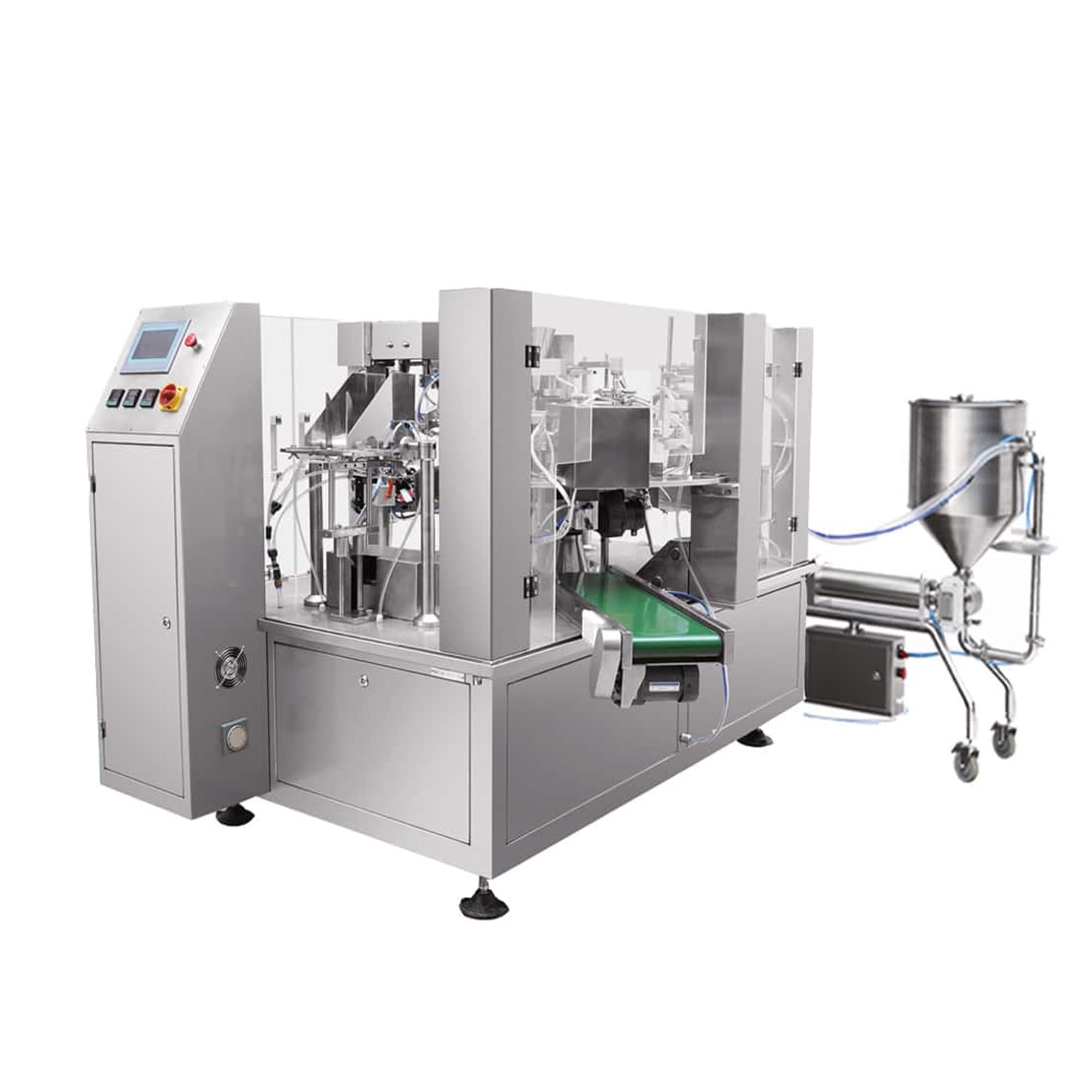
Bottles remain the territory of dedicated bottle lines with their own filler family, and they interact with pouch decisions mostly through co-packing economics rather than filling physics. If your product roadmap spans both, choose the filler principle by viscosity first and treat the container question as a downstream module.
For product-specific pairings, our ketchup and sauce packaging solutions page groups machine configurations by sauce category, which is faster than reasoning from first principles for common products.
| Mistake | Symptom on the line | Prevention |
|---|---|---|
| Gravity filler on a pourable sauce | Dripping nozzles, stringing, underfilled packs | Move to positive displacement: lobe or piston |
| Viscosity measured cold, product filled hot | Machine tuned for the wrong product behavior | Measure and trial at filling temperature |
| Particulate product on plain piston valves | Bridged valves, drifting piece distribution | Oversized valves, agitated hopper, bottom-up fill |
| Nozzle cut-off ignored for stringy sauces | Product on the seal zone, leakers after packing | Suited cut-off (wire, blade) plus suction; verify seal zone cleanliness |
| One filler bought for the whole sauce range | Band 4 product starves the next batch of upgrades | Plan by product roadmap, not by today's SKU |
| Sealing parameters never revisited after product change | Weak seals on the same machine that ran fine | Re-qualify seal temperature and dwell per product family |
The most expensive row is the last one, because it looks like a machine problem while actually being a product-change problem. A filler that ran a thin sauce perfectly will leak on a thicker one with unchanged sealing settings: thicker product holds more heat, stringing increases, and the seal zone sees contamination it never saw before.
A rotational viscometer with a temperature-controlled cup gives a usable reading, and contract labs run single samples inexpensively. For band placement you do not need perfect numbers: measure at filling temperature, note the behavior when stirred, and record the particulate load. Suppliers can usually place your band from a sample plus a photo of the label, but your own measurement removes guesswork from the conversation.
Sometimes, and the honest answer depends on the gap. A piston filler can usually run a thinner product acceptably; a lobe pump usually cannot run a thick paste. Machines with changeable filling modules exist for wide ranges, but every added range costs accuracy or speed somewhere. Define your product roadmap first, then ask suppliers to demonstrate the two extremes on one configuration.
Most often because product reached the seal zone before the jaws closed: stringing from the nozzle, splashing at cutoff, or a fill level set too close to the top seal. The fixes are mechanical (nozzle design, cut-off type, fill height, suction) rather than thermal. Raising seal temperature to compensate contaminates the weld with product and weakens it.
Band 4: a piston filler with particulate-capable valves, piping sized to the largest piece, an agitated hopper to keep pieces suspended, and bottom-up filling for clean level control. Confirm the largest particle size and solids share with the supplier in writing, because "chunky" spans a wide range and the valve sizing depends on the actual number.
Yes, and it is a legitimate strategy rather than a shortcut: hot-fill lines rely on lower hot viscosity for clean filling, then the product thickens as it cools in the sealed pack. The rule is to band and tune the product at the temperature it meets the filler, and to re-check weights once the line reaches steady state, because first-hour behavior and steady-state behavior differ on heated products.
Not sure which bagging setup fits your product and output target? Send us your product details, bag format and target speed, and get a machine recommendation and quote.
Contact: LTC Bagging System
Phone: +8613337332946
E-mail: [email protected]
Add: Wenzhou, Zhejiang Province, China