Flow wrap or bag: for bakery and snack producers this is the first fork in the road, and the product itself casts the vote. Shape-stable items, biscuits, bars, bread rolls, crackers, belong to the flow wrapper, which carries each piece on a conveyor and seals film around it. Free-flowing products, chips, nuts, granola, flour-based mixes, belong to the bagging line, which drops a weighed dose into film formed into a pouch. Almost every confused purchase we see traces back to answering this question by brand preference or by which supplier called first, instead of by product. Five questions settle it: product shape, sell unit, freshness needs, shelf presentation and line layout. Each is below, followed by a product-by-product mapping and the hybrid lines where both formats meet.
Key takeaways
Shape-stable individual items (biscuits, bars, bread) go to flow wrapping; free-flowing bulk (chips, nuts, granola) goes to bagging. Geometry decides, not preference.
Sell unit is the second vote: one bar or a counted stack is flow wrap territory, a weighed handful is bag territory.
Freshness needs differ by seal geometry: flow wrap seals around the product, bags seal across a wide mouth with headspace and often gas flush.
Shelf presentation favors printed film faces for flow wrap and standing pouches for bags; retail category expectations usually make the call for you.
Line layout is a hard constraint: flow wrappers run long and horizontal, baggers run tall and vertical. Measure the floor before dreaming.
| Your product | Format that wins | Why |
|---|---|---|
| Biscuits, cookies, crackers (single or stacked) | Flow wrap | Shape-stable, needs individual seal and printed face |
| energy bars, chocolate bars | Flow wrap | One piece per pack, high counts, register-printed film |
| Bread rolls, buns, flatbreads | Flow wrap or bag | Flow wrap for singles, bagging for family counts |
| Chips, puffed snacks | Bagging (VFFS) | Fragile and free-flowing, needs headspace and gas flush |
| Nuts, trail mix, granola | Bagging (VFFS or pouch) | Weighed bulk fill, resealable formats common |
| Multipacks (6 cookies in one bag) | Both, in sequence | Flow wrap each cookie, then bag the counted stack |
One distinction before the details, because buyers mix these up: flow wrap versus bagging is a package format question, while vertical versus horizontal machine orientation is a machine architecture question. They overlap heavily, and our companion guide to vertical and horizontal packaging machines works through the machine side, footprint, handling and changeover. This article stays on the format side: which package your product should leave the factory in.
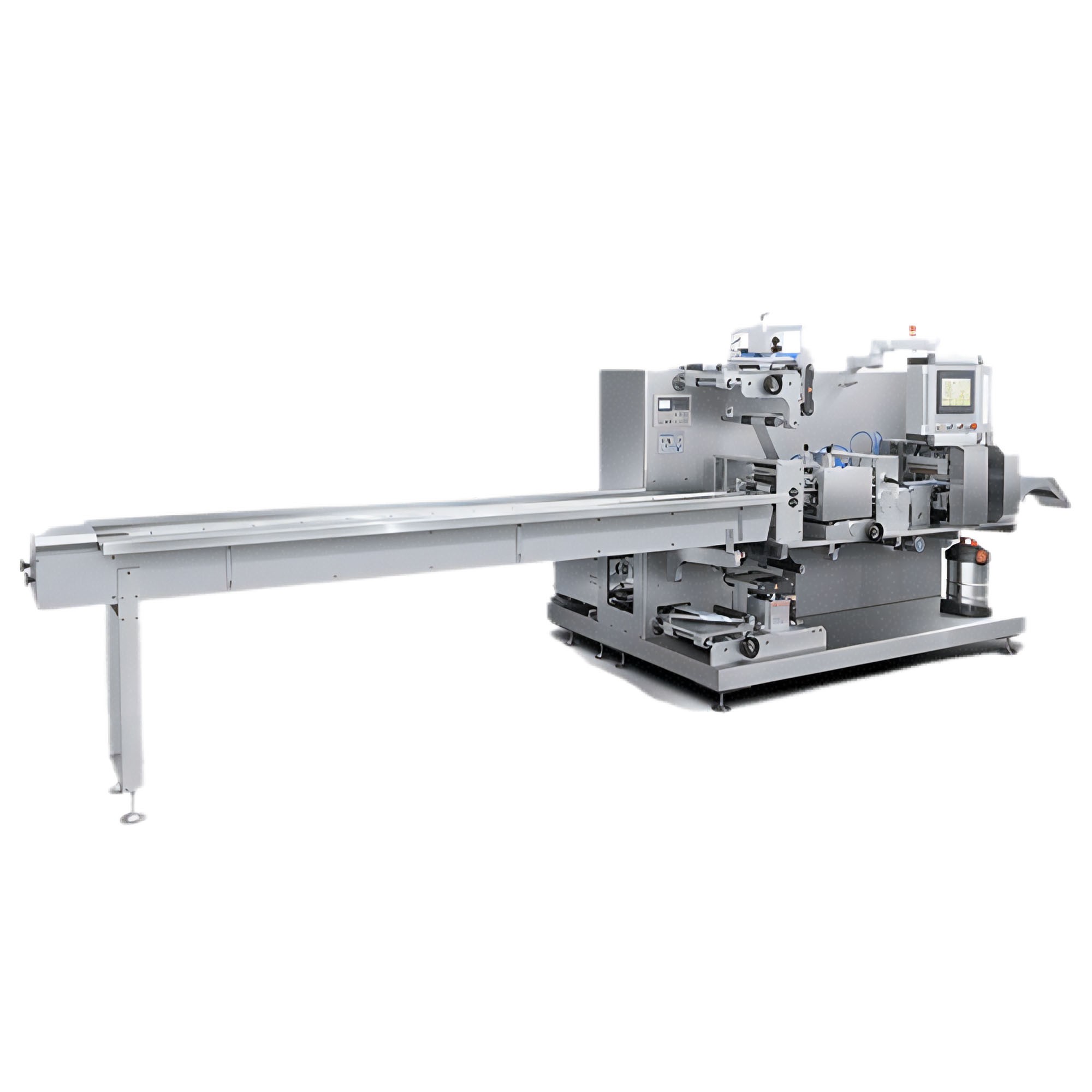
A flow wrapper seals film around a moving product. Infeed spacing sets the rhythm: each item sits on a conveyor at a fixed pitch, film wraps over or under it, rotating wheels close a fin seal along the bottom or top, and rotary or reciprocating jaws seal and cut both ends. The product never drops, never tumbles. The pack is a tight sleeve around the item, with the seal running the full circumference of each end.
A bagging line forms a pouch, then fills it. Film pulls down around a forming collar into a tube, a lengthwise seal closes it, a dosing system drops a weighed or counted dose from above, and cross seals close and cut the bag. The product falls into the package, so the dosing system, not the product shape, is the heart of the line. Bags carry headspace, survive gas flush, and open into a wide mouth the consumer can reach into.
The mechanical difference maps exactly onto the product difference: carried items versus dropped product. Every question below is a consequence of that single fork.
Question 1: is the product shape-stable or free-flowing? Pick up a unit of your product. If it holds its shape and survives gentle handling, flow wrapping is on the table. If it flows, crumbles or must be weighed rather than counted, it goes into a bag. This single test removes half the machine market from consideration before any supplier conversation. Two edge cases worth naming: sticky bakery items need special infeed designs regardless of format, and delicate cookies can be shape-stable but fragile, which pushes toward flow wrap with gentle feeders rather than any drop at all.
Question 2: what is the sell unit? One bar, one biscuit, one sandwich: flow wrap. A stack of six crackers: flow wrap with a stacking section before the film. A 150 gram handful of chips: bagging, because no feeder stacks a handful. Multipacks combine both in sequence, which is why Question 2 beats Question 1 when they disagree: a counted, stackable unit can be flow wrapped even when the product itself is fragile, while anything sold by weight is bagged no matter how robust the pieces are.
Question 3: what freshness does the format need to deliver? Flow wrap puts a tight sleeve with end seals around the product, which suits barrier films and long shelf life for dry bakery, and modified atmosphere is possible when the line supports gas flushing before the end seals close. Bags seal across a wide mouth and routinely run nitrogen flush for chips, where fragile contents need both cushioning headspace and oxygen control. The practical rule: shelf-life spec belongs in the machine brief either way, and the format choice should follow the barrier and atmosphere your category demands, not the other way round.
Question 4: what does the shelf demand? Flow wrap prints on the film face with the brand wrapping the product itself, lying flat in the display box or on the shelf. Bags stand up, hang from header seals or fill pillow-style into cases. Look at what the category already does: biscuit aisles are sleeves and flow-wrapped stacks, snack aisles are standing pouches and pillow bags. Matching the category is not conformity, it is what retail buyers and consumers parse instantly.
Question 5: what line layout and speed class fit your floor? Flow wrappers run long, product in one end, packs out the other, so the constraint is linear floor space. Baggers run tall, with the dosing system above the film tube, so the constraint is ceiling height and platform access. On speed class, the choice inside flow wrapping itself spans three tiers: an automatic flow wrapping machine as the mainstream production workhorse, a high-speed class for long runs of a single format, and a semi-automatic flow wrap machine where an operator loads product and the machine handles film, seal and cut. Pick the tier by your run lengths and labor plan, not by catalog maximums.
| Product | Typical format | The deciding factor |
|---|---|---|
| Plain biscuits, crackers | Flow wrap, single or stack | Printed face, tight seal, counted units |
| Filled or coated biscuits | Flow wrap with care | No drop allowed, carried infeed |
| Energy and cereal bars | Flow wrap | One piece per pack, high counts |
| Bread rolls, buns | Flow wrap or film bag | Local category convention decides |
| Sliced loaf | Bag with header | Bagging suits the shape and re-closure |
| Chips and puffed snacks | Pillow bag, gas flush | Weighed fill, headspace, oxygen control |
| Nuts and trail mix | Bag or stand-up pouch | Weighed fill, resealability premium |
| Cookies sold in 6-packs | Flow wrap then bag | Hybrid: primary sleeve, secondary bag |
For bakery-specific pairings beyond this table, our bread and bakery packaging solutions page groups machine configurations by product family, which is faster than reasoning format by format.
The two formats are not rivals across a wall. The classic snack line is a chain: a flow wrapper seals each cookie or bar as the primary pack, and a bagging line downstream counts six of them into a printed pillow bag as the multipack the shelf actually sells. Bakeries run the same logic with film-bagged bread packed into flow-wrapped outers, and snack makers bag flow-wrapped minis into sharing pouches.
Two consequences for buying. First, sequence matters: buy the primary pack machine first, because its output format defines the secondary machine's infeed. Second, integration scope matters: when both machines come from the same project, quote the transfer between them, the conveyor, the counting or stacking, inside the line price, or the cheapest pair of machines becomes the most expensive line.
| Mistake | What it costs later | The check before signing |
|---|---|---|
| Bagging a counted product because the bagger quote was cheaper | A counting system bolted on at extra cost and slower speed | Run Question 2 before comparing quotes |
| Flow wrapping a fragile item with a gravity feeder | Breakage rates that eat the format's savings | Specify carried or assisted infeed, test on your product |
| Choosing format by catalog speed | A machine that hits rated speed on rounds and half of it on your shape | Trial with your actual product and film |
| Forgetting gas flush in the brief | Shelf life misses category requirements | Put shelf-life spec in the machine brief up front |
| Buying primary and secondary machines separately | An infeed mismatch discovered at commissioning | Quote the transfer between machines in the line |
No, because the mechanics differ at the root: one carries a shape-stable item through film, the other forms a pouch and drops product in. Plants that need both run two machines in sequence, primary pack then secondary multipack, and the integration between them is part of the real line cost.
Bagged, almost always. Chips are fragile and sold by weight, so they need a weighed fill into a bag with headspace, usually with nitrogen flush. Small format chips portions do exist in flow wrap, but the mainstream category runs vertical bagging lines.
Neither is cheaper in general, because material use differs: flow wrap consumes film proportional to product dimensions, bags add headspace and a wider seal area. Cost per pack is an arithmetic question on your product, film price and pack count, and it belongs in the format decision rather than a rule of thumb.
A flow-wrapped pack is a tight sleeve sealed around a shape-stable product, with a fin seal along one face and closures at both ends. A pillow bag is a formed pouch with side folds, a wide top seal and headspace around the product. The first carries, the second contains.
They do when the infeed is specified for it: soft bakery runs on carried or assisted infeeds with gentle product control, never gravity drops. This is exactly the detail to test at the supplier with your own bread, not a demonstration product, before you commit.
Not sure which bagging setup fits your product and output target? Send us your product details, bag format and target speed, and get a machine recommendation and quote.
Contact: LTC Bagging System
Phone: +8613337332946
E-mail: [email protected]
Add: Wenzhou, Zhejiang Province, China